Ice Loading Calculations
Variables needed:
Nominal Ice Thickness in inches, t
Fence Height in feet, h
Height of fencing materials in feet, s (h minus any gap at the bottom of the fence)
Topographic Factor, Kzt
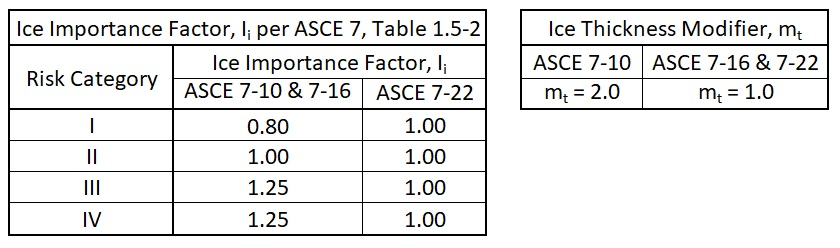
Importance Factor for Ice, Ii (not used in ASCE 7-22, so Ii set to 1.0 in that case)
Ice Thickness Modifier, mt (corrects for formula differences between ASCE 7 versions)
Height Factor, fz per Eq. 10.4-4 (½ h substituted for z to average across the vertical surface)
fz = (½ h / 33)0.10
Design Ice Thickness for Freezing Rain in inches, td per Eq. 10.4-5
td = mt t Ii fz Kzt 0.35
For Kzt = 1.0, Eq. 10.4-5 simplifies to td = mt t Ii fz
The Density of Ice, Id = 56 lbs / ft3 per ASCE 7 §10.4.1 (minimum value)
For a solid fence:
Iced Area in ft2, Ai = 0.8 s L (0.8 is reduction factor for vertical plates per §10.4.1)
The Volume of Ice in ft3, Vi = π (td / 12)Ai per Eq. 10.4-1
The Weight of Ice in lbs, Di = (0.7)Vi Id (0.7 ASD reduction factor per ASCE 7 §2.4.3 for Wind on Ice loading)
For open fencing, the ice solidity ratio, ε’ is based on adding the design ice thickness, td to each free edge of the fencing members which increases the wind area. If the iced solidity ratio, ε’ exceeds 0.7, the fence is then considered to be a solid or mostly solid fence.
The cross sectional area of ice on each member is based on the “diameter of the cylinder circumscribing an object”, Dc in inches. Dc for a variety of cross sections is shown below per ASCE 7, Figure 10-1. This is only used for determining the weight of the ice, not the wind area.
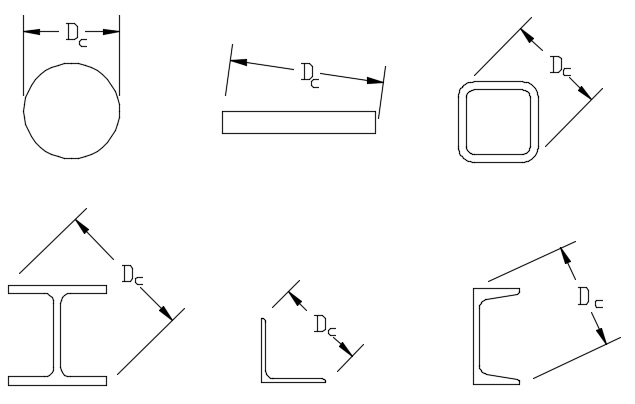
The cross-sectional area of Ice in ft2 per Eq. 10.4-1 is Ai = π td (Dc + td) / 144
The volume of ice on a given member, such as a tube picket on an architectural fence would be:
Vi = Ai x the length of the member in feet.
See above for determining the weight of the ice.