Fence Post Footing Design Per EP486
The IBC post footing design procedure appears to be based on research conducted in the 1960’s and does not seem to have been updated since that time. It is typically conservative and requires less calculation effort than the more modern EP486 approach.
Footing design per EP486 is more complicated than the IBC procedure, but on larger projects, the savings in excavation and concrete can be worth the extra effort, especially in clay soils.
EP486 is designed around more complex footings designed for heavy loading including uplift, but there are sections of the standards that apply to fence post footings (Embedded Posts).
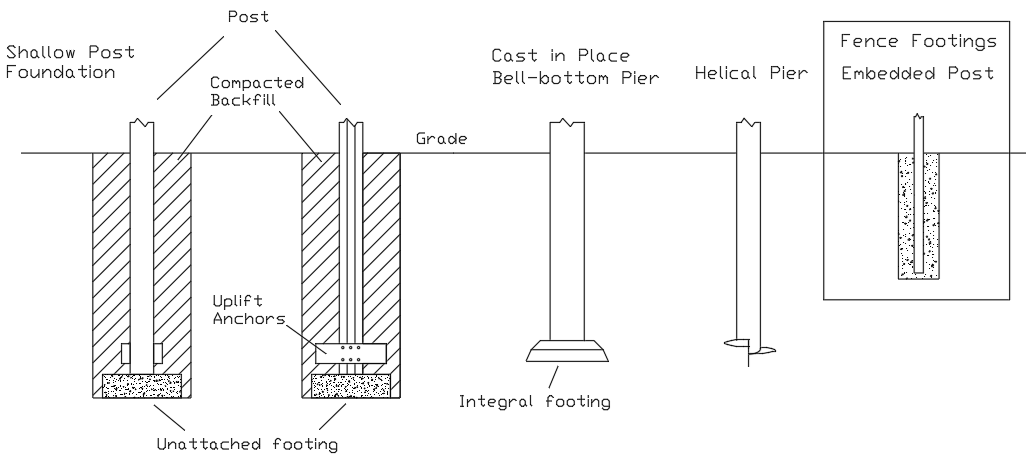
There are currently 3 different versions of EP486:
- EP486.1 which is referenced by IBC 2003 through IBC 2012
- EP486.2 which is referenced by IBC 2015 & 2018
- EP486.3 which is referenced by IBC 2021 & 2024
EP486.1 is similar to the IBC procedure, but more detailed. EP486.2 is completely different and based on more modern research. EP486.3 is an update on the EP486.2 standard.
The EP486.2 & .3 standards have a complex Universal Procedure that has to be used if there are different soil types within the depth of the footing. This is beyond the scope of this design guide which only covers the Simplified Procedure.
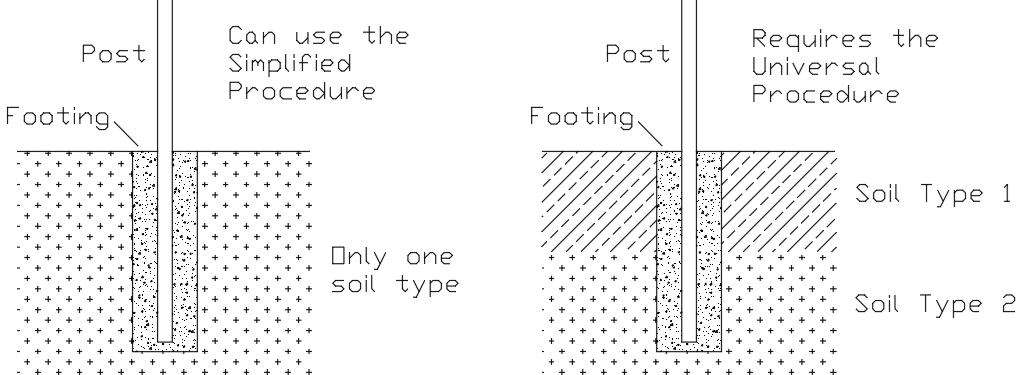
.
Below is a comparison between the IBC procedure and EP486.2 / EP486.3 for the same forces used in the design example at the end of the post footing page. In this specific set of examples, using the lowest safety factors based on the most useful geotechnical test data for each soil type, the EP486 procedure provides a considerable savings in excavated soil and concrete required. General geotechnical data for the site not ordered specifically for fence post sizing may result in less savings in cohesionless soils. (dirt, sand & gravel)
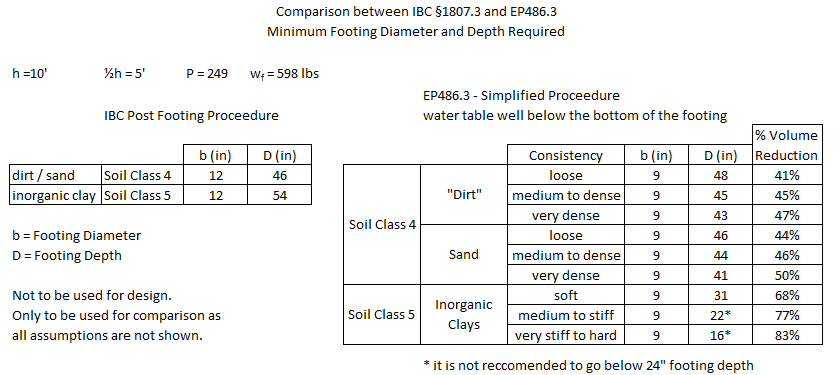
.
For non-expansive cohesive inorganic clay soils, (Soil Class 5), just having the soil class and consistency verified by construction testing from the soils report is sufficient to allow for the use of the lowest safety factors / most economical footings.
For cohesionless soils (Soil Class 3 & 4 – dirt, sand & gravel), the depth of the water table affects the axial strength. If the water table depth is not known, you have to assume that it is above the bottom of the footing which could result in larger footing diameters. Having the soil class and consistency verified by construction testing from the soils report drops the required safety factors by 40 to 60%.
If other, more specific tests were ran, you can get even lower safety factors or higher strengths but this increases the cost of the report.
Documents on the use of the different EP486 versions with the FenceDesign.com design procedures are linked below.
.
A calculator for the simplified proceedure will be included in the upcoming Fence Design Tool.
.
The National Frame Builders Association has a free calculator excel file for EP486.3 which can do both the Simplified and Universal Procedures. There are instructions for the NFBA calculator here and a youtube video by the author explaining it’s use here.